
I’ll never forget the afternoon I sat in my home office, staring at a screen that told me my business was essentially invisible. I had spent six months and a small fortune on ‘high-authority’ guest posts from big-name tech blogs. I had the backlinks, the domain authority was climbing, and yet, my shop was nowhere to be found when someone two blocks away searched for my services. It was a gut-punch realization: Google didn’t care about my mention on a global news site if the local chamber of commerce didn’t even know my name. This is where most of us trip up when trying to dominate business map pack rankings. We chase the shiny, global numbers and completely ignore the guy next door. Today, I want to show you how I stopped wasting money on generic links and started using regional backlinks to actually move the needle for my geo-targeted campaigns.
Stop Chasing Viral Links and Start Getting Local
I made a massive mistake early on by thinking that a link is just a link. It isn’t. When you are fighting for top map pack placement, Google is looking for geographical relevance. Think of it like this: if you’re looking for a great pizza place in Chicago, are you going to trust a food critic from London or your neighbor who’s lived there for twenty years? Google works the same way. Regional backlinks act as a digital ‘vouch’ from your community. When a local high school, a neighborhood blog, or a regional news outlet links to you, it signals to the algorithm that you are a legitimate entity within that specific coordinate. I found that local link building requires more than just generic citations; it requires being a part of the local conversation. According to research by Moz, local organic rankings are heavily influenced by the ‘locality’ of the linking domain, not just its raw power.
Is regional link building actually worth the extra effort?
I know what you’re thinking because I thought it too: ‘It’s so much harder to get a link from a local newspaper than to just buy a package of 50 generic links.’ You’re right, it is harder. But those 50 generic links are often why your map pack placement never moves. I once spent weeks trying to get a single link from a local charity I sponsored, and that one link did more for my rankings than an entire month of ‘standard’ SEO. Why? Because it’s a signal that can’t be easily faked. Have you ever felt like you’re doing everything ‘by the book’ but still getting outranked by a competitor with a worse website and fewer reviews? They probably have the local community talking about them online.
Why Proximity is King but Link Context is the Queen
You can’t just change your address and expect to win. You need to prove you belong there. This is why sponsoring local teams builds better backlinks than almost any other strategy I’ve tried. It provides a natural, geo-relevant anchor that tells Google exactly where you operate. If you aren’t seeing your business show up in that coveted top three, it’s time to stop looking at global metrics and start looking at your own backyard. In the next section, I’m going to break down the exact outreach strategy I use to land these regional gems without sounding like a desperate salesperson.
Identify Your Real Neighbors Online
To start, you need a hit list of local domains that Google already trusts to define your area. I’m not talking about Yelp or YellowPages; I’m talking about the high school football booster club, the local rotary group, or that one hyper-active neighborhood blog that reports on every new pothole. These sites might have a low global domain authority, but their local authority is through the roof. When you get a link from a site that only talks about your city, you are effectively telling Google’s algorithm that you are a pillar of that specific community. This is a critical move to rank business maps effectively in the local pack because it provides a geographical anchor that generic links simply cannot replicate. Think of a generic link as a stranger saying you’re a nice guy, whereas a local link is your next-door neighbor vouching for your character to the police. Which one carries more weight?
Stop Asking for Links and Start Offering Value
The biggest mistake I see is the ‘cold pitch’ that looks like a form letter. If you want a local pack entry to happen naturally, your outreach needs to be human. I remember a time when I was working with a local HVAC company that was struggling to break into the top three. We stopped sending generic ‘guest post’ emails and instead reached out to a local community garden. We didn’t ask for a link; we offered to donate two hours of labor to fix their shed’s ventilation. The resulting ‘thank you’ post on their highly relevant local blog did more for his map pack placement than a $2,000 SEO package ever did. It was messy, it took time, but it was real. 
Use Local Sponsorships to Beat the Proximity Trap
One of the most frustrating things in SEO is the ‘proximity trap’ where Google only shows your business to people within a tiny radius of your front door. You can break this invisible barrier by securing links from surrounding neighborhoods. If you are based in North Austin but want customers in South Austin, you need links from South Austin entities. This is exactly why sponsoring local teams builds better backlinks; it allows you to choose your geographical signal. When you sponsor a Little League team in the next town over, their website links back to your mappack listing or website, expanding your relevance zone. I’ve used this tactic to help businesses how to fix the proximity trap keeping you out of the map pack. It’s about creating a ‘geo-relevance web’ that stretches further than your physical storefront ever could.
Audit Your Citations for Hidden Leaks
Before you go out and hunt new links, make sure your existing ones aren’t working against you. I once spent months building new regional links for a client, only to realize their old address was still listed on a prominent local news site from five years ago. That one ‘NAP’ (Name, Address, Phone) discrepancy was confusing the algorithm and stalling their progress. You have to ensure your data is clean because how outdated citations stealthily damage your map pack placement is a real phenomenon that can negate even the best backlink strategy. I now make it a rule to do a deep-clean of every local brand mention before starting a new outreach campaign.Once your citations are clean, you might think the hard work is over. But this is exactly where most local business owners plateau. I’ve seen countless entrepreneurs get frustrated because they’ve checked every box on the beginner’s list, yet their competitors are still winning the prime real estate. Let’s dig deeper into the mechanics that actually separate the leaders from the laggards in 2024 and beyond.
Forget Everything You Know About Keyword Stuffing
The biggest myth I encounter is that your Google Business Profile description functions like a traditional webpage for SEO. I’ve watched people spend hours meticulously crafting descriptions filled with city names and service keywords, only to see zero movement in the rankings. The reality is that why your google business description doesnt actually affect your ranking is a hard pill to swallow, but it’s true. Google uses the description for the user, not for the algorithm’s ranking engine. If you’re obsessing over that field while ignoring your primary category selection or your interaction rates, you’re playing the wrong game. Have you ever fallen into this trap? Let me know in the comments.
Does a higher star rating actually guarantee a better spot?
It seems logical: a 4.9-star rating should beat a 4.2-star rating every time. However, in my experience, velocity and recency are far more powerful than the raw average. This is often why your mappack listing is losing to competitors with fewer reviews; they might have ten reviews from the last month, while yours are two years old. According to the 2023 Local Search Ranking Factors study by Whitespark, ‘behavioral signals’ like click-through rate and mobile ‘get directions’ clicks are now significantly more impactful than old, static feedback. Google wants to see that you are relevant *now*, not that you were great three years ago. If you aren’t engaging with the feedback you get, you’re making the review response mistake that stops google from showing your profile to new callers. 
Avoid the service area overlap that kills visibility
Here is a nuance that even some ‘experts’ miss: the service area conflict. If you are a service-based business (like a plumber or a mobile detailer), you might be tempted to select every zip code within a 50-mile radius. Don’t do it. I’ve discovered that the service area conflict that secretly blocks your local pack entry occurs when your areas are too broad or overlap awkwardly with other locations you might have. It dilutes your geographical ‘centroid,’ making Google unsure of where you truly provide the most value. Instead of casting a mile-wide net that is an inch deep, focus on the core areas where you can prove your relevance through local links and photos. In the future, we will even see businesses rank business maps higher using 2026 crowd density heatmaps, where real-time physical presence matters more than any digital setting. Stop trying to trick the map and start dominating the specific neighborhoods that actually drive your revenue.
Stop Guessing and Start Seeing Your Real Search Radius
When I first started, I used to check my rankings by standing in my office and searching on my phone. It was a rookie mistake. I looked like I was winning, but three blocks away, I was invisible. Now, I rely exclusively on grid-style tracking to use a Google Maps rank tracker effectively. If you aren’t looking at a 13×13 grid of your city, you aren’t seeing the reality of your map pack placement success. I personally prefer tools that don’t just give me a number but show me the exact ‘heat map’ of where my authority drops off. This is how you identify the specific neighborhoods where your competitors are vulnerable. By using 3 minimalist tools, I can pinpoint whether I’m losing ground because of a lack of reviews or a genuine proximity issue. 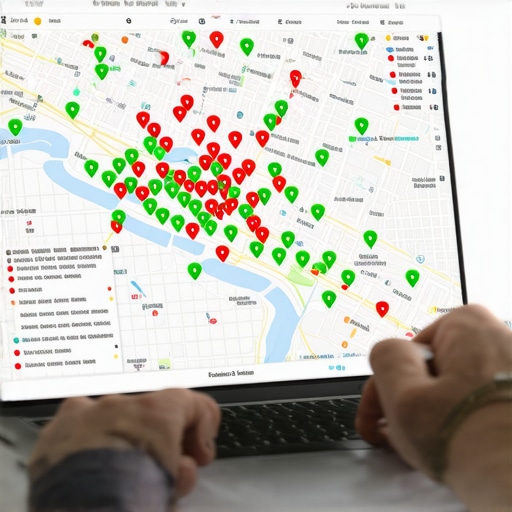
Keep the Momentum Going Without Burning Out
The biggest threat to your mappack listing isn’t a new competitor; it’s your own stagnation. Google’s algorithm has a high ‘freshness’ bias. I’ve seen businesses fall out of the top three simply because they stopped uploading photos for a month. I recommend a ‘low friction’ maintenance schedule: one new geo-tagged photo and one review response per week. This isn’t just busy work; it’s a small review tweak that proves to the algorithm you are still open for business. According to Joy Hawkins of Sterling Sky, the ‘Vicinity Update’ significantly increased the importance of relevance and decreased the weight of keyword-rich business names, meaning your active engagement matters more now than ever.
How do I maintain my map pack dominance over the long haul?
Maintenance is about defensive SEO. You need to keep an eye on ‘suggested edits’ from the public, which competitors sometimes use to sneakily change your hours or phone number. I also suggest periodically checking your 7 hidden ranking factors to ensure no technical errors have crept into your backend. As we look toward the future, I predict that by 2026, Google will lean even harder into real-time signals. We are already seeing the groundwork for businesses to rank business maps higher using 2026 crowd density heatmaps. This means the physical foot traffic and ‘live’ popularity of your location will eventually override traditional backlinks. My advice? Don’t wait for the future to happen to you. Go out tonight, run a grid search for your primary keyword, and see where your ‘green zone’ actually ends. If it’s smaller than five miles, it’s time to start that regional outreach I mentioned earlier.
The Map Pack Realities I Learned the Hard Way
Looking back at my own journey to rank business maps, I realized that the algorithm isn’t just a machine to be gamed, but a reflection of how a community interacts with a brand. One of my biggest lightbulb moments was realizing that ‘perfect’ SEO doesn’t exist if your customers aren’t actually clicking your profile; Google tracks the ‘long-click’ where someone stays on your listing or calls you directly. I also found that the tiny profile edit that finally jumpstarts stalled impressions is usually about fixing a category mismatch or updating a stale photo, not just adding more keywords. Finally, I stopped obsessing over global metrics and started focusing on my ‘neighborhood footprint.’ If you can get the local high school or a neighborhood association to mention you, you’ve won a signal that no competitor can buy with a generic offshore link package.
My Go-To Stack for Local Dominance
To stay ahead of the curve, I rely on a few specific resources that strip away the fluff. I always suggest using a dedicated grid-tracking tool to visualize your search radius; it’s the only way to see if you’re actually making progress or just getting lucky because you are standing in your own lobby. For citation management, I prefer manual audits over automated services because reclaiming your map pack spot without paying for expensive lead gen often requires fixing deep-seated data errors that robots miss. I also keep a folder of geo-tagged photos on my phone to upload regularly, as keeping a fresh mappack listing is a major trust signal for the algorithm. #IMAGE_PLACEHOLDER_E#
Take Control of Your Neighborhood Traffic
Dominating the business map pack isn’t a one-time project; it’s an ongoing commitment to your local digital presence. It requires you to be present, to be helpful, and to be consistently active in the eyes of the digital neighborhood watch. We have seen how to increase google profile clicks without buying new reviews simply by showing up and engaging with the community you serve. You have the blueprint, you have the strategies, and most importantly, you have the local knowledge that no global agency can replicate. It’s time to stop letting your neighbors find your competitors first and start claiming the visibility your business deserves. What do you find more challenging: landing those elusive regional backlinks or getting your customers to leave a consistent stream of reviews? Let me know below!