I’ll never forget the sinking feeling in my gut when I realized I had spent six months chasing the wrong tail. I was helping a friend with his boutique gym, and despite having better reviews than everyone on the block, his business map pack presence was non-existent. We were doing the “right” things—posting updates, getting mentions—but we were invisible. Then, it hit me. I had listed him as a “Physical Fitness Program” instead of “Gym.” One tiny change, and forty-eight hours later, he popped into the top three like magic. It was a total lightbulb moment that changed how I approach a mappack listing forever.
The Day I Realized My Category Choice Was Sabotaging My Rankings
When you set up your profile, that primary category field feels like just another form to fill out. In reality, it is the single most important piece of data you give to Google. It’s the “hook” that catches the algorithm’s attention. If you choose a category that doesn’t align with what people actually type into that search bar, you’ve lost before you even started. I see so many owners struggle with map pack placement simply because they tried to be too specific or, ironically, too broad. This isn’t just about being accurate; it’s about being strategic. Today, I want to show you exactly how to stop guessing and start winning with the category choices that actually move the needle.
Is one tiny dropdown menu really that powerful?
You might be thinking, “Surely Google is smart enough to know what I do?” Well, yes and no. While AI has come a long way, the primary category remains the strongest relevance signal in the local ecosystem. According to the Whitespark Local Search Ranking Factors survey, primary category remains the top ranking factor for local pack results. If you ignore this, you’re essentially shouting into a void. I learned this the hard way when I tried to fix a local pack entry for a consultant who insisted on a category that no one actually searched for. We wasted months on standard SEO when the fix for your mappack listing was right under our noses the whole time.
Stop Thinking Like a Business Owner and Start Thinking Like a Searcher
The biggest mistake I made early on—and I still see people doing it every day—is choosing a category based on what we want to be called, rather than what customers actually type. You might call yourself a “Culinary Experience Provider,” but your customers are looking for a “Catering Service.” This disconnect is why so many struggle with their local pack entry. You have to align your identity with their intent. Have you ever felt like you’re doing everything right—getting reviews, taking photos—but your business is still buried on page three? If that sounds like you, your category choice might be the silent killer of your business map pack success. We’re going to dive into how to audit your choice and find the “Goldilocks” category that fits just right.
If you want to dominate your local area, you have to stop treat your category choice like a throwaway setting. Think of your primary category as the main department sign in a massive grocery store. If you hang a ‘Pharmacy’ sign over the produce section, people will eventually find the apples, but the store’s management system—in this case, Google—will be hopelessly confused. To rank business maps effectively in the local pack, that sign has to match the very first thing your customers expect to see.
Look at What the Top 3 Are Doing Right Now
Before you touch your own settings, you need to conduct a mini-audit of the current winners. Open a private browsing window, type in your most valuable keyword, and look at who is sitting in the top three spots. The category listed just below their business name is their primary category. This is the blueprint for your own map pack placement. If all three competitors are listed as ‘Personal Injury Attorney’ and you are listed as ‘Law Firm,’ you are fighting an uphill battle. Google is literally telling you what it wants to reward for that specific search term. I once saw a landscaping company jump from the tenth spot to the second just by changing ‘Gardener’ to ‘Landscape Designer’ because that’s what the local ‘winners’ were using. It sounds almost too simple, but it is the cornerstone of mastering business map pack keys to top map pack placement.
How to Choose Secondary Categories That Actually Work
While the primary category does the heavy lifting, your secondary categories act like the aisles that lead people to specific products. You are allowed up to ten categories in total, but more isn’t always better. The goal here is to support your primary choice, not dilute it. If your primary is ‘Pizza Restaurant,’ your secondary choices should be ‘Italian Restaurant,’ ‘Pizza Delivery,’ or ‘Pizza Takeout.’ Adding ‘Catering Service’ might seem helpful, but if it’s not a core part of your daily operations, it can actually muddy the waters of your business map pack profile. Every secondary choice should be a direct subset of what you do, reinforcing the main ‘hook’ you’ve set for the algorithm.
The Move That Saved a Struggling Restoration Company
Last summer, I worked with a water damage restoration company in Florida that was doing everything right—great reviews, plenty of photos—but their local pack entry was stuck on the second page. They had only selected ‘Water Damage Restoration Service’ as their category. I did a quick audit and noticed their competitors were also leveraging ‘Fire Damage Restoration’ and ‘Building Restoration Service.’ We implemented this simple change to rank business maps for multiple services, and within twelve days, they were hitting the top 3 for several high-intent neighborhood keywords. They didn’t need more backlinks; they just needed to tell Google the full story of their expertise.
Check the Source Code to See Competitor Secrets
If you want to see every single category a competitor is using—even the ones hidden from the front end—there is a geeky but effective shortcut. On a desktop, go to the competitor’s listing on Google Maps. Right-click anywhere on the page and select ‘View Page Source.’ Press ‘Ctrl+F’ and type in their primary category name. You will see it listed in the code, and often, right next to it in the same string of text, you will find the secondary categories they are using to maintain their mappack listing dominance. This is the most accurate way of optimizing your map pack entry for better local search rankings because you are looking at the raw data Google is processing.

However, be careful of ‘Category Bloat.’ I’ve seen businesses try to be everything to everyone, adding ‘Consultant,’ ‘Marketing Agency,’ and ‘Web Designer’ all at once. This triggers a relevancy crisis. Google prefers a specialist over a generalist in the local ecosystem. If you find your map pack placement is dropping, the first thing you should check is if you’ve added too many conflicting categories. Sometimes, the best mappack listing fix for incorrect business categories is simply deleting the ones that don’t belong.
Let’s dig deeper. If you’ve been in the local SEO game for a while, you’ve probably heard that ‘citations are king.’ I’m here to tell you that’s a dangerous half-truth. In the early 2010s? Sure. Today? Not even close. I’ve seen businesses with a hundred messy citations outrank those with ‘perfect’ data because Google has moved toward entity-based signals. The truth is that why ranking business maps requires more than just standard SEO comes down to what we call real-world interaction. According to research by Joy Hawkins at Sterling Sky, the proximity of the searcher and the ‘search intent’ of the user are now far more influential than a list of directory links from five years ago. This shift is why your map pack placement might suddenly drop even if your ‘NAP’ (Name, Address, Phone) is consistent everywhere. You need to understand that why your local pack entry requires real-world signal data is about how users interact with your listing—do they click for directions, or do they just keep scrolling?
Citations are no longer the silver bullet they used to be
One of the biggest traps I see ‘advanced’ marketers fall into is the virtual office shortcut. It’s tempting to rent a mailbox or a shared desk in the city center to grab a local pack entry in a high-traffic area. But here is the warning: Google’s ‘Vicinity’ update made it incredibly easy for the algorithm to sniff out these ‘ghost locations.’ If your business doesn’t have permanent, physical signage visible from the street, you’re playing a dangerous game. This is the risk of using virtual offices for map pack placement; you might gain a week of traffic only to face a permanent suspension that is nearly impossible to appeal. I’ve had to break the news to three different clients this year that their ‘prestigious’ downtown address was the very thing keeping them off the map entirely.
Why does my map pack rank drop the moment I leave my office?
This is one of the most frustrating things for business owners to realize. You check your rank at your desk and you’re #1, but you drive three blocks away and you disappear. This happens because Google’s proximity filter has become incredibly tight. It’s no longer about who is the ‘best’ in the city; it’s about who is the most relevant in that specific 500-yard radius. If you are trying to learn how to rank business maps in the next town over, you have to realize that standard optimization won’t cut it. You need localized content on your site that signals geographic relevance to that specific area. This is also why your map pack placement sinks when you travel outside your zip code—Google assumes you are no longer the most convenient option.
The tracking trap that leads most owners astray
Most people rely on basic rank trackers, but why most local SEO tools fail to track true map pack placement is that they only check from one fixed point. Real users are moving. They are on mobile data, switching between towers, and searching while walking. To truly understand your performance, you need a grid-based tracking system that shows you where your ‘bubbles’ of visibility actually end. Have you ever fallen into this trap of thinking you were ranking everywhere just because you saw yourself at the top while sitting in your own breakroom? Let me know in the comments—I’d love to hear how you’ve tackled these proximity hurdles.
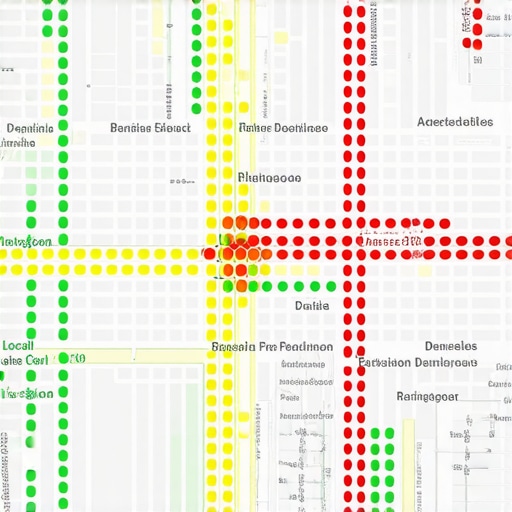
If you are tired of the ‘desk-side ranking’ trap I mentioned earlier, you need a way to see the truth without driving all over town. I’ve moved almost exclusively to grid-tracking tools for all my clients. Why? Because it shows me a literal heatmap of where a mappack listing is winning and where it is losing. If I see a red dot just three blocks north, I know I need to focus my next local post on that specific neighborhood. This is exactly how to monitor map pack placement without expensive software if you are willing to do a little manual legwork, but the visual data from a grid is what saves my sanity. I have seen businesses think they are dominating an entire city, only to realize their visibility ‘kingdom’ is only two streets wide.
Stop Blindly Trusting Your Desktop Search Results
The single most important tool in my arsenal isn’t a fancy AI writer; it’s a geographic rank tracker that mimics mobile GPS. When you look at your map pack placement from your office, you’re getting a biased result. Google knows you’re there. To get the real story, you need to see how a customer at the local mall sees you. I use these heatmaps to determine the only map pack placement metric that actually matters for ROI: the total ‘covered area’ in square miles. If that area isn’t growing, your business isn’t growing, no matter what your total review count says.
How do I maintain my map pack rank over the long haul?
Maintenance isn’t about one big push; it’s about the ‘drip’ of relevance. I tell everyone I work with that the moment you stop feeding the beast, the beast starts looking for a new favorite. This is why your map pack placement drops after you stop posting updates. Google interprets silence as inactivity. You don’t need to write a novel every day, but you do need to upload a fresh photo or a quick ‘What’s New’ post at least once a week. I’ve personally watched a #1 local pack entry slip to #5 in less than a month simply because the owner went on vacation and stopped responding to reviews. In the eyes of the algorithm, a stagnant profile is a dying business.
The Future is AI and Ultra-Specific Attributes
Looking ahead, I predict that the ‘Search Generative Experience’ (SGE) will make your business attributes more valuable than your description. Google is already pulling data from ‘Knows about’ tags and specific service menus to answer complex voice queries. This is why your business map pack profile needs fresh attributes monthly. If you haven’t checked your ‘Amenities’ or ‘Service Options’ lately, you’re leaving money on the table. According to Google’s Business Profile documentation, relevance is calculated by how well a local profile matches what someone is searching for—and those tiny checkboxes for ‘Free Wi-Fi’ or ‘Wheelchair Accessible’ are becoming major weight-bearers for rank business maps success.
My best advice? Set a calendar reminder for the first Tuesday of every month. Don’t just look at your reviews—look at your competitors’ newest photos. If they have better ground-level shots than you, go outside with your phone and take five more. It sounds tedious, but this is the ‘secret’ to map pack placement that the big agencies don’t want you to know: consistency beats cleverness every single time. Take one action today: log in and add three specific service attributes you haven’t checked yet. You might just see a jump by tomorrow morning.
What I Wish Someone Told Me Before I Obsessed Over Citations
I spent years thinking that having a thousand citations on every obscure directory was the secret sauce. I was wrong. The biggest lightbulb moment for me was realizing that Google prioritizes real-world relevance over digital clutter. If you want to outrank local competitors with higher review counts for business maps, you have to look at the signals that prove you are active and trusted right now. I also learned the hard way that why your map pack placement depends on your reviews velocity is often more important than the total number of stars you have. A business that gets three reviews a week looks much more ‘alive’ to the algorithm than one that got fifty reviews three years ago and then went silent.
The Minimalist Toolkit That Keeps Me at the Top
You don’t need a massive budget to dominate your local area. I personally rely on three main things. First, I keep the official Google Business Profile Help Center bookmarked—it is the only 100% reliable source of truth when the algorithm shifts. Second, I use a grid-based tracker to see my actual visibility ‘bubbles’ rather than just a single point on a map. Third, I focus on manual checks. You can actually learn how to audit your map pack placement without subscription software by using simple browser extensions or incognito windows from different locations. These tools provide the raw data needed to make smart, evidence-based decisions for any mappack listing.
Your Roadmap to Local Dominance Starts Now
The business map pack isn’t a mystery reserved for tech giants; it’s a level playing field for those willing to do the work. Don’t feel like you have to change everything overnight. Start by checking your primary category, then move to your attributes, and finally, focus on getting consistent, high-quality photos uploaded. Every small adjustment contributes to your overall map pack placement and signals to Google that you are the most relevant option for your neighbors. It’s time to stop being the best-kept secret in your city and start being the first name people see. Have you noticed your local pack entry performing differently on mobile versus desktop lately? Let me know your experience in the comments below!