I remember staring at that little Google postcard like it was a winning lottery ticket. I had just finished the verification process for my first local project, and I genuinely believed the clouds would part and customers would start raining down. I refreshed the search results for my main keyword and… crickets. Not only was I not in the top three, but I wasn’t even on the first page. It was a total reality check that taught me a hard lesson: proving you exist to a search engine is not the same thing as proving you’re the best choice for a neighbor. If you’ve been wondering why your pins aren’t showing up despite having a ‘verified’ status, you’re in the right place. We’re going to fix your local pack entry strategy by looking at the signals that actually move the needle.
Why That Google Postcard is Only the Beginning
I’ll be honest with you—I wasted nearly six months of my life focusing on the wrong things. I thought if I just got enough citations, I’d be golden. But I quickly realized that your citations alone won’t improve your map pack placement if your profile is a ghost town. Verification is like getting your driver’s license; it proves you’re allowed to be on the road, but it doesn’t make you a NASCAR driver. To really rank business maps effectively, you need more than a confirmed address. You need real-world engagement and a profile that screams ‘trust me.’ My early mistake was assuming Google would do the work for me once I proved my mailbox existed. Don’t make that same error.
Is it even possible for a small guy to beat the big chains?
This is the question I get asked more than any other. You see these massive national brands with huge budgets and you think, ‘How can my little shop compete?’ The truth is, most small businesses struggle with map pack placement because they try to play the corporate game. But the map pack favors relevance and proximity. In fact, research from BrightLocal shows that nearly 87% of people look at reviews before making a local decision. That means a local business with 50 genuine, heartfelt reviews can absolutely crush a national chain with 500 robotic ones. It’s about being the most relevant answer to a searcher’s specific problem, not just the biggest brand in the zip code. Have you ever felt like you’re doing everything by the book but still seeing your competitors take all the calls? Let’s break down how to change that starting right now.
Keep the Reviews Coming Faster Than the Competition
If reviews are the fuel for your rank business maps engine, then review velocity is the gas pedal. I once worked with a landscaper who had a perfect 5.0 rating but only three reviews from 2019. He was effectively dead in the water. To secure a local pack entry that stays put, you need a steady stream, not a one-time flood. Google isn’t just looking for quality; it’s looking for current relevance. Think of it like a restaurant—would you trust a review from four years ago saying the fish is fresh? Probably not. This is why your map pack placement depends on your reviews velocity more than just the raw number. It’s also about the dialogue; the local pack entry move responding to every review signals that you are active and attentive, which the algorithm loves.
Your Smartphone is Your Best SEO Tool
Stop using stock photos. Seriously, just stop. People can smell a generic office photo from a mile away, and so can the AI. I used to think high-end photography was the key to map pack placement, but I found that raw, authentic shots taken from a phone actually performed better. Why? Because they provide ‘ground-truth’ data. When you take a photo of your storefront, the metadata often includes coordinates that prove you are where you say you are. Make sure your mappack listing needs ground-level exterior photos so customers can literally see the door they are about to walk through. It sounds simple, but why your mappack listing needs customer-uploaded photos is about social proof that money can’t buy.

One Wrong Category Can Make You Invisible
Here is a micro-story about how I almost ruined a client’s business. They were a hybrid ‘Bakery and Cafe.’ Initially, I set their primary category as ‘Cafe’ because they wanted to sell more coffee. Their business map pack ranking for ‘fresh sourdough’—their high-ticket item—vanished instantly. I realized too late that the mappack listing fix for incorrect business categories isn’t just a minor tweak; it’s the foundation of your entire visibility. If you choose a category that is too broad, you’re competing with everyone; too narrow, and no one finds you. We had to follow the exact steps to fix a mappack listing with conflicting categories to get them back on the map. It was a messy two-week period of checking their mappack listing daily, but it taught me that precision beats ambition every time. You have to be what people are actually searching for, not just what you want to be known as.
The Proximity Myth and What You Can Actually Control
A lot of people think they can’t rank business maps because they aren’t in the exact center of downtown. That’s a trap. While you can’t move your building, you can control your ‘relevance radius.’ I once helped a gym on the edge of town beat a franchise in the city center by focusing on hyper-local content. We used the best way to mention nearby landmarks for map pack placement on their website and matched it to their profile. By anchoring the business to known local spots in the text, we signaled to the algorithm that they were the go-to spot for that specific side of the city. It’s about building a digital fence around your neighborhood so strong that Google can’t ignore it.
Don’t Just Stuff Keywords Into Your Business Name
Common wisdom in the local SEO world says you should add your city and main service to your business title on Google. While you might see a temporary spike, I’ve watched dozens of entrepreneurs lose everything because why your mappack listing needs more than just a keyword-rich name is about long-term survival. Google’s spam filters are smarter than they were three years ago. If your legal name is ‘Joe’s Garage’ but your listing says ‘Joe’s Garage Best Auto Repair Chicago,’ you are begging for a suspension. In my experience, building a brand that people actually search for by name is a much more stable way to rank business maps effectively. This is the biggest ‘oops’ factor I see: chasing a short-term algorithm loophole that eventually leads to a permanent ban.
The Proximity Trap That Limits Your Growth
You’ve probably heard that proximity is the number one ranking factor. This leads many to believe they are stuck in a small radius around their office. I used to believe this too, until I realized why ranking business maps requires more than just standard SEO. You can actually ‘expand’ your reach by focusing on behavioral signals. According to the 2023 Local Search Ranking Factors study by Whitespark, ‘conversions’ and ‘personalization’ are becoming heavier weights in the algorithm. This means if people consistently click your listing even when you are further away, Google starts to widen your reach. You need to provide why your local pack entry requires real-world signal data like direction requests and phone calls from diverse locations to break out of your immediate zip code. Have you ever fallen into this trap? Let me know in the comments.
Why does your ranking drop when you leave the neighborhood?
If you have ever checked your rank while sitting at your desk and then noticed it vanishes when you drive three miles away, you are seeing the ‘proximity filter’ in action. To fix this, you need to stop thinking about your local pack entry as a static object. It is a living entity that needs to be fed local context. I often suggest clients why you should ignore most map pack placement techniques you see online that focus purely on backlinks and instead look at the only map pack placement metric that actually matters for roi: user engagement. If your mappack listing isn’t getting clicks, Google assumes you aren’t relevant to that area. It’s a harsh reality, but once you master the art of earning the click, the map boundaries start to blur in your favor. I’ve helped businesses dominate three towns over just by optimizing for user intent rather than just distance.
Stop Trusting Generic Rank Trackers
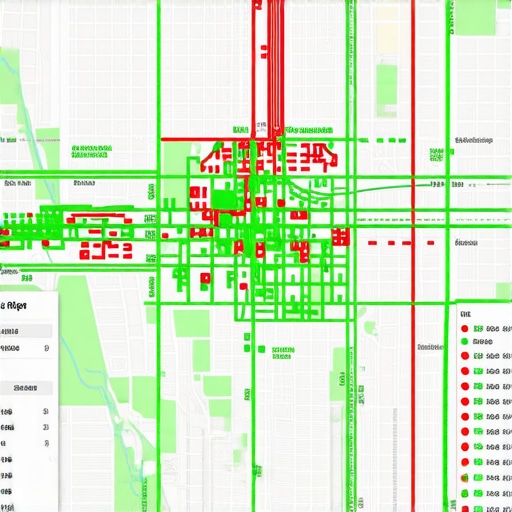
For the longest time, I was flying blind. I would type my business name into a standard SEO dashboard and see ‘Rank #1,’ then drive two blocks away, search on my phone, and find myself at #8. This is exactly why most local SEO tools fail to track true map pack placement; they often pull data from a single IP point, ignoring the hyper-local grid that Google actually uses. To truly rank business maps, you need to see the ‘heat map’ of your city. I personally switched to grid-based tracking tools like Local Falcon, which show you exactly where your local pack entry starts to fade. If you aren’t using a grid, you’re only seeing 1% of the picture. I also frequently use the simple tool that checks your mappack listing health to ensure there are no technical glitches or ‘shadow suspensions’ hiding under the hood.
My Personal Toolkit for Local Dominance
I don’t believe in overcomplicating things with five different subscriptions. I keep it lean. Every Monday, I perform a quick scan using the best way to audit your business map pack profile without expensive tools—this usually involves an incognito mobile search and a check of my ‘Google Business Profile’ insights. If I see a dip, I look at my post frequency. Most people treat their business map pack profile like a statue, but it’s actually a garden. I’ve noticed that why your map pack placement drops after you stop posting updates is often tied to ‘freshness’ signals that the algorithm uses to determine if a business is still active. If you stop posting photos or updates for three weeks, don’t be surprised when your mappack listing starts sliding down the results. As Darren Shaw from Whitespark recently highlighted in his research, the ‘Open Now’ filter is becoming a massive conversion driver, so I also make sure my holiday hours are updated well in advance.
How do I keep my map position steady year after year?
Maintenance is less about massive overhauls and more about micro-habits. I treat my profile like a social media feed. My prediction for the next few years? Google is going to lean heavily into Visual AI. Soon, the algorithm won’t just ‘see’ your keywords; it will analyze the actual content of your videos to verify you offer what you claim. This is the local pack entry hack using video on your profile that will separate the winners from the losers by 2026. If you want to scale, you need to think about automation that doesn’t feel robotic. Use a scheduler for your updates, but keep the content raw and local. My biggest piece of advice is to never get comfortable. A competitor could move in across the street tomorrow, and if they are more active than you, Google will reward them. Keep your data clean and your engagement high.
Ready to take the next leap? Stop worrying about your city-wide rank and start digging into the technical side. I highly recommend you learn how to rank business maps using advanced schema markup today. Adding LocalBusiness schema to your website is the most effective way to ‘whisper’ directly into Google’s ear about exactly who you are and where you serve. Go try it on your homepage right now—it’s the one move that provides an almost immediate clarity boost for your map pack placement.
Three Hard Truths About Why Local Listings Actually Fail
In my first year, I thought a few backlinks would be enough to secure my spot, but I quickly learned that why most local pack entry strategies fail after three months is a lack of real-world engagement. You can’t simulate the trust of a neighbor. Another surprise was that you don’t even need a storefront to dominate; the map pack placement strategy for service-based businesses without a storefront proves that relevance beats a physical lobby every time. The most important lesson? Google trusts your customers more than it trusts your dashboard. If your business map pack profile doesn’t reflect a living, breathing business, you’re just a ghost in the machine.
The Tools I Use for Constant Growth
I keep my strategy lean by using only what works. Every month, I perform a health check using the simple tool that checks your mappack listing health to ensure no algorithm update has knocked my mappack listing out of alignment. To see through the fog of digital noise, I rely on the best way to audit your business map pack profile without expensive tools. And for that extra edge that most competitors ignore, I strongly suggest you learn how to rank business maps using advanced schema markup. These resources have consistently helped me maintain a local pack entry that survives even the most volatile updates.
Claim Your Future in the Local Search Results
The digital landscape is constantly shifting, but the need for local expertise never goes away. Your map pack placement is a powerful asset that can transform a struggling shop into a neighborhood staple. Don’t wait for the perfect moment to start; the best time to optimize was yesterday, and the second best time is right now. Commit to being the most active, honest, and helpful option in your area, and you will see the results in your call volume. Have you ever noticed your ranking drop when you leave your shop’s immediate area? Let me know your experience in the comments below!